In stock & shipping in the U.S. OSHA · ANSI · CSA compliant
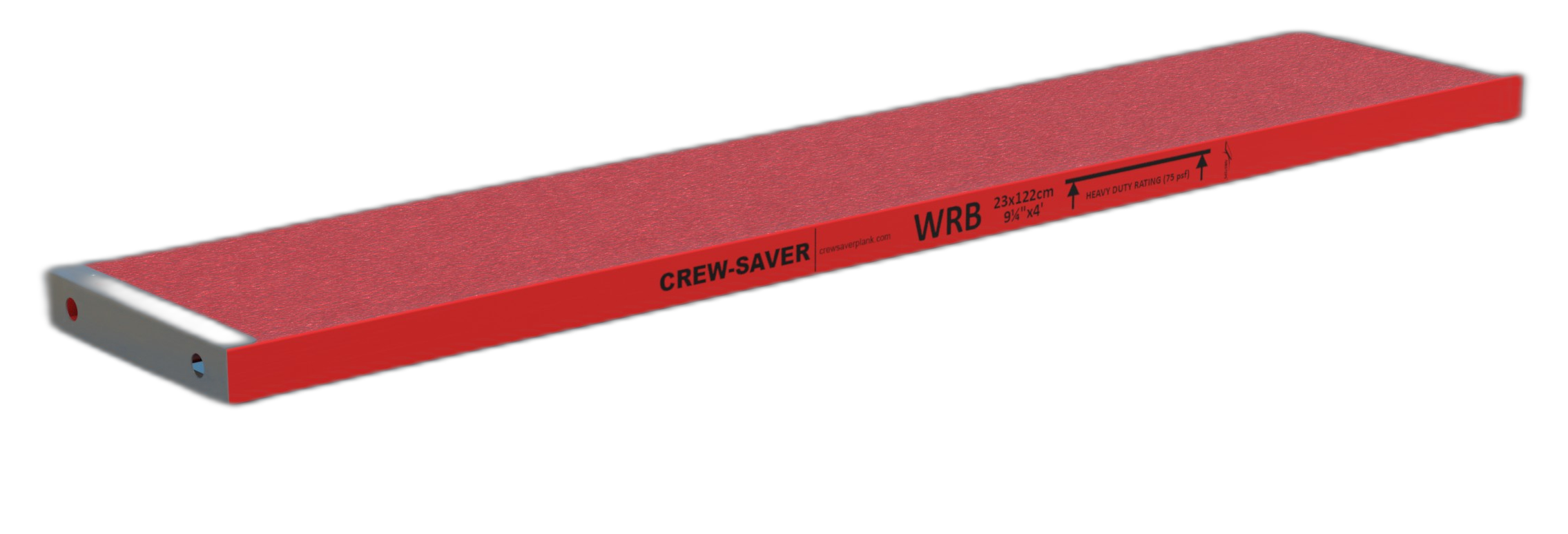
Crew-Saver WRB composite scaffold plank — red pultruded fiberglass deck with anti-slip top and metal end caps
Composite Scaffold Plank · Now Stocked in the U.S.

BUILT TOSAVE THE CREW.

Crew-Saver is the composite fiberglass scaffold plank that's lighter than wood, lighter than steel, never splinters, and never gains a pound in the rain. Engineered to protect the hands that build the world.

Compare to Wood & Steel
54%
Lighter than wood
59%
Lighter than steel
0 / 0
Splinters / water gain
16.8
lb · 10′ plank
50 psf
@ 10′ span
0%
Water absorption
9.25″
Standard width
USA
In stock now

A wet plank doesn't just slow a crew down. It puts them at risk.

According to OSHA, the planking is the single most critical component of any scaffold. Yet most crews still work on a material that warps, rots, splinters, and quietly gains weight every time it rains.

01
Water weight
Wood can absorb 10–30% of its weight in moisture. A soaked plank hoisted 60 feet up is a fatigue and drop hazard before it's ever an ergonomics problem.
02
Splinters & failures
Splitting grain shreds gloves, embeds in hands, and hides structural failure. Every splinter is a small injury — and a warning you can't always see.
03
Constant replacement
Rot, warp, and decay mean wood planks are condemned, pulled, and re-bought on a cycle that never ends — and never gets cheaper.
WET.
HEAVY.
WORN.
"Planking is the single most critical component of any scaffold."
— OSHA

One plank. Three problems engineered out.

01

No Splinters.
Ever.

Pultruded fiberglass forms a single, sealed surface with a molded anti-slip top. There's no grain to split, no fibers to shed, and nothing to tear a glove or a palm — shift after shift, year after year.

Sealed composite surface
02

Same Weight,
Wet or Dry.

The closed composite structure absorbs zero moisture. A Crew-Saver plank pulled from a downpour weighs exactly what it weighed on the truck. No warping, no rot, no hidden weight landing on a tired crew.

0% water absorption
03

Stronger
Where It Counts.

Pound-for-pound stronger than structural timber, with consistent deflection from plank to plank. Non-conductive for live electrical work, self-extinguishing, and immune to chemicals, salt, and welding slag.

OSHA · ANSI · CSA compliant

A 10-foot plank a crew can actually carry.

Same length. Same 9¼″ width. A fraction of the load. Here's what one standard 10′ scaffold plank weighs, by material.

Crew-Saver
Composite
17LBS
Wood
Scaffold plank
37LBS
Steel
Galvanized hook
41LBS
24 lbs
lifted off every single plank versus steel. Multiply that across a deck, a crew, and a shift — that's fewer injuries, faster builds, and lower labor cost.

Why crews are switching to composite scaffold plank.

Wood is cheap up front and expensive forever. Steel is strong but brutal to handle. Crew-Saver fiberglass plank is engineered to beat both on the things that actually cost you time, money, and safety.

FeatureCrew-Saver CompositeWood PlankSteel Plank
Weight (10′ plank) ~16.8 lb~37 lb~41 lb
Water absorption Zero — same weight wet or dryAbsorbs 10–30%None, but rusts
Splinters None — sealed surfaceSplits & splintersNone (sharp edges)
Rot / corrosion Immune to rot & chemicalsRots & decaysRusts & corrodes
Electrical conductivity Non-conductiveConductive when wetConductive
Consistent deflection Plank-to-plank consistencyVaries by boardConsistent
Service life Long life, low maintenanceFrequent replacementLong, but heavy
Compliance OSHA · ANSI · CSAGrade-dependentStandard

The $25 plank is the expensive one.

A wood plank is cheaper to buy and far more expensive to own. It splits, rots, and gets condemned — so you buy it again, and again. Here's the real math on a single 8′ plank over a 10-year span.

Wood Plank · 8′
$25/ plank
Low sticker price — that's the whole pitch.
Useful life
~24 months
…if you're lucky and it's treated well.
Crew-Saver · 8′
$60/ plank
Costs more once. Then it just keeps working.
Useful life
10+ years
No rot, no warping, no condemning.

What you actually spend over 10 years

Per 8′ plank · same fleet, kept in service for 10 years
Wood5 planks @ $25
$125
Crew-Saver1 plank @ $60
$60
52%
less, over a decade — even though Crew-Saver costs more than double up front. That's $6/yr per plank versus $12.50/yr for wood, before you count the labor of pulling and replacing condemned boards.

Scale it to your fleet

Drag to size your inventory and see the 10-year difference.

100planks
Wood · 10-yr cost
$12,500
Crew-Saver · 10-yr cost
$6,000
You keep
$6,500

More deck. Same crew. Same shift.

Plank erection speed scales with weight handled. When your plank weighs less, your crew moves more of it — and arrives at the end of the shift in better shape.

20 lb
less per plank vs wood
24 lb
less per plank vs steel
2.2×
more planks per man-hour vs wood

Cumulative lift eliminated per shift

Scaffold planks are lifted, carried, and set dozens to hundreds of times per shift — often overhead, often multiple lifts up. At 20 lb less per plank than wood, a crew eliminates thousands of pounds of cumulative load per person per day. That's fewer soft-tissue strains, fewer lost workdays, and less fatigue-driven error late in the shift.

Measurable output lift for the same crew

Because scaffold production is measured in weight handled per man-hour, a plank that weighs 55% less means the same crew can erect more than twice as much deck per shift versus wood — and nearly 2.5× more versus steel. That's faster scaffold-ready dates, earlier access for other trades, and lower labor cost per square foot of platform installed.

Put it to work from our rental fleet.

You don't have to make the investment today. Crew-Saver is part of the ScaffSource rental fleet — get it on the job now, prove it out in the field, and buy when the math is obvious. Hit Request a Quote to see rental rates, sizes, and availability.

In stock and ready to ship.

Crew-Saver composite scaffold plank is stocked in the U.S. in the four most-used lengths, with 12′ available as a special order. All planks are 9.25″ wide to match standard wood plank.

LengthComposite weightWood weightWeight savedAvailability
4′9.7 lb15.0 lb35% In stock
6′12.1 lb22.5 lb46% In stock
8′14.6 lb30.0 lb51% In stock
10′16.8 lb37.5 lb55% In stock
12′19.4 lb45.0 lb57% Special order

Weights are nominal, per plank. All planks are 9.25″ wide.

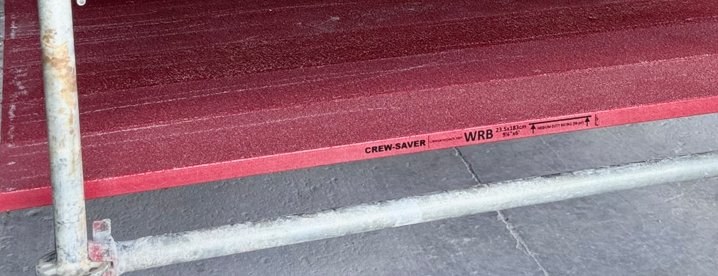
Crew-Saver composite scaffold plank installed on a live jobsite

In Stock and
Ready to Ship.

No backorders. No ocean freight lead times. Crew-Saver is warehoused in the U.S. and ships from domestic stock — spec it today and have it on the job when you need it.

4′, 6′, 8′, and 10′ in stock — 12′ special order
Ships from U.S. inventory, no import delays
Drop-in replacement for standard 9.25″ wood plank
Buy outright or rent from the ScaffSource fleet

Pultruded fiberglass, built as one piece.

Crew-Saver is pultruded — continuous glass fiber and resin pulled through a heated die into a single hollow box profile with internal stiffening ribs and an integral anti-slip deck. No lamination to delaminate. No grain to fail.

MaterialPultruded fiberglass (FRP)
Nominal size1.5″ × 9.25″
Allowable load50 psf @ 10′ · 75 psf @ 7′
SurfaceMolded anti-slip, non-skid
Water absorption0% (waterproof)
ElectricalNon-conductive, high dielectric
FireSelf-extinguishing, fire-retardant
ResistanceCorrosion · UV · chemical · slag
ComplianceOSHA · ANSI · CSA · 3rd-party tested

Built for the jobs that punish ordinary plank.

Refineries & Petrochem

Corrosion-proof against chemicals, salt, and process exposure.

Electrical & Utility

Non-conductive, high-dielectric for work near energized lines.

Commercial Construction

Lighter handling means faster erecting and fewer crew injuries.

Marine & Wastewater

Immune to marine borers, rot, fungi, and constant moisture.

Shipyards & Offshore

Lightweight, weatherproof platforms that survive salt spray.

Food & Clean Process

Won't shed splinters or harbor decay — ideal for wash-down.

Backed for the U.S. market

Tested, compliant, and in stock now.

OSHA
Compliant
ANSI
Compliant
CSA
Compliant
3rd Party
Tested
USA
In stock

Crew-Saver is distributed and stocked in the United States by ScaffSource, a Brock Group company — with the inventory, logistics, and field support to put it on your jobsite, not on a backorder list.

Composite scaffold plank FAQ.

Still deciding?

Get a sample plank in hand, request the full spec sheet, or talk pricing and lead times with our team.

A 10-foot Crew-Saver composite plank weighs about 16.8 lb, versus roughly 37 lb for a comparable wood plank and 41 lb for galvanized steel — about 54% lighter than wood and 59% lighter than steel. Shorter lengths weigh proportionally less (a 4′ plank is just 9.7 lb).
Yes. Crew-Saver is pultruded fiberglass (FRP), which is electrically non-conductive with high dielectric capability — making it well suited for scaffolding near energized electrical lines, unlike steel or wet wood.
No. The closed composite structure absorbs zero moisture. The plank doesn't warp, rot, or gain water weight, so it weighs the same wet or dry — even after years of exposure.
Yes. Crew-Saver meets OSHA, ANSI, and CSA scaffold plank standards and is third-party tested for the North American market.
We stock 4′, 6′, 8′, and 10′ lengths in the U.S., with 12′ available as a special order. All planks are 9.25″ wide.
Yes. Crew-Saver is designed to work with existing frame and systems scaffolding and matches the standard 9.25″ nominal width of wood plank, so it drops into your current setup.
Wood is cheaper to buy but more expensive to own. An 8′ wood plank runs about $25 but lasts roughly 24 months before it splits, rots, or gets condemned. An 8′ Crew-Saver plank is about $60 and lasts 10+ years. Over a decade that's roughly $125 in wood (five replacements) versus $60 for one Crew-Saver — about 52% less, before you even count the labor of pulling and replacing condemned boards. Contact us for current pricing and volume quotes.
Yes — and the advantage is durability, not a claim that fiberglass is a “greener” raw material than timber. Because one Crew-Saver plank outlasts roughly five wood planks over a decade, a fleet uses about 80% fewer planks per position — far less material to manufacture, ship, and ultimately send to landfill. It also avoids the constant disposal of condemned scaffold lumber, which is often pressure-treated and harder to dispose of cleanly. The greenest plank is the one you don't have to keep re-buying.
This is where the material itself wins. Producing pultruded fiberglass takes roughly one-quarter to one-sixth the energy of producing the equivalent capacity in steel or aluminum, so its embodied carbon is substantially lower. Add the light weight — more planks per truckload and fewer replacement deliveries over a fleet's life — and the total production-and-transport footprint lands well below metal decking.
After 10+ years of service, the composite can be shredded into granulate and repurposed as filler in concrete, asphalt, or road base, or used for energy recovery. It isn't infinitely recyclable the way a metal is — but because each plank lasts so long and replaces multiple wood planks, the total material sent to disposal over time is dramatically lower than a wood-plank program.
Let's get you a plank in hand

FEEL THE
DIFFERENCE.

Request a sample, ask for a spec sheet, or get pricing and lead times for outfitting your next scaffold with Crew-Saver. It's in stock and ready to ship.